

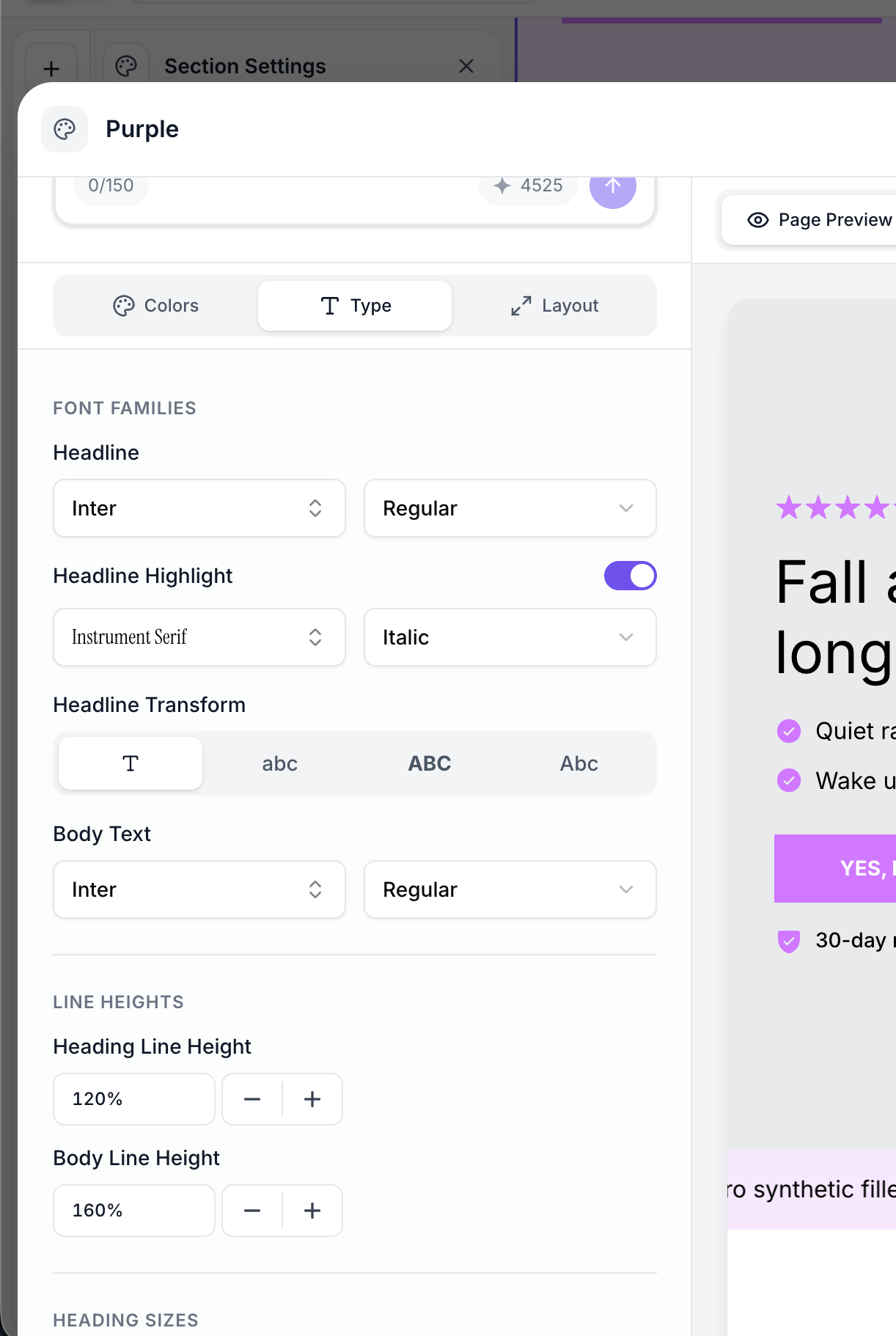
The Typography tab in the Brand Style modal.
Font Families
Your brand style uses up to three font families, each serving a different purpose:Heading Font
The heading font is used for all headings (H1 through H6) across your landing page sections. This is typically the most distinctive font in your design — it sets the visual tone for your brand.- Choose from 1,500+ Google Fonts or upload a custom font
- Example: Poppins, sans-serif
Body Font
The body font is used for paragraphs, descriptions, labels, and all non-heading text. It should be highly readable at smaller sizes.- Choose from Google Fonts or upload a custom font
- Can be the same as or different from the heading font
- Example: Poppins, sans-serif
Text Highlight Font
The highlight font is a special font used for emphasized text — words or phrases that you wrap in highlight formatting within your sections. It is often a decorative or contrasting font (like a serif or script) that draws attention to key phrases.- Only active when text highlighting is enabled in your brand style
- Typically a serif or handwriting font to contrast with sans-serif heading/body fonts
- Example: Instrument Serif, serif
Font Weights
Font weights control how thick or thin your text appears. Different weights are configured for different text types:
Available weight values depend on the selected font. Common weights include:
- 100 — Thin
- 200 — Extra Light
- 300 — Light
- 400 — Regular
- 500 — Medium
- 600 — Semi-Bold
- 700 — Bold
- 800 — Extra Bold
- 900 — Black
Not all fonts support all weights. The weight dropdown in the Brand Style modal only shows weights that are available for the currently selected font. If you switch fonts, the weight may reset if the new font does not support the previously selected weight.
Font Sizes
EcomWize lets you set font sizes separately for desktop and mobile screens. This ensures your text is optimally sized for every device.Heading Sizes (H1 - H6)
Each heading level has independent desktop and mobile sizes:Paragraph Sizes (P1 - P3)
Three paragraph size tiers are available for different text contexts:Button Font Size
Buttons have their own font size setting, independent of paragraph sizes:Text Transform
Text transform controls the capitalization of text. Two text transform settings are available:Heading Text Transform
Applies to all headings (H1-H6) across your page:Button Text Transform
Applies to all button labels:
Default for both: None
Uppercase text transforms are popular for buttons in bold, energetic brands (fitness, energy drinks). More refined brands typically use “None” or “Capitalize”. Uppercase headings can work for minimal designs but should be used carefully as they reduce readability for longer text.
Line Heights
Line height controls the vertical spacing between lines of text. Two line height properties are available:
Line heights are expressed as percentages relative to the font size. A 120% line height on a 40px heading means 48px of vertical space per line. A 160% line height on a 16px paragraph means 25.6px per line.